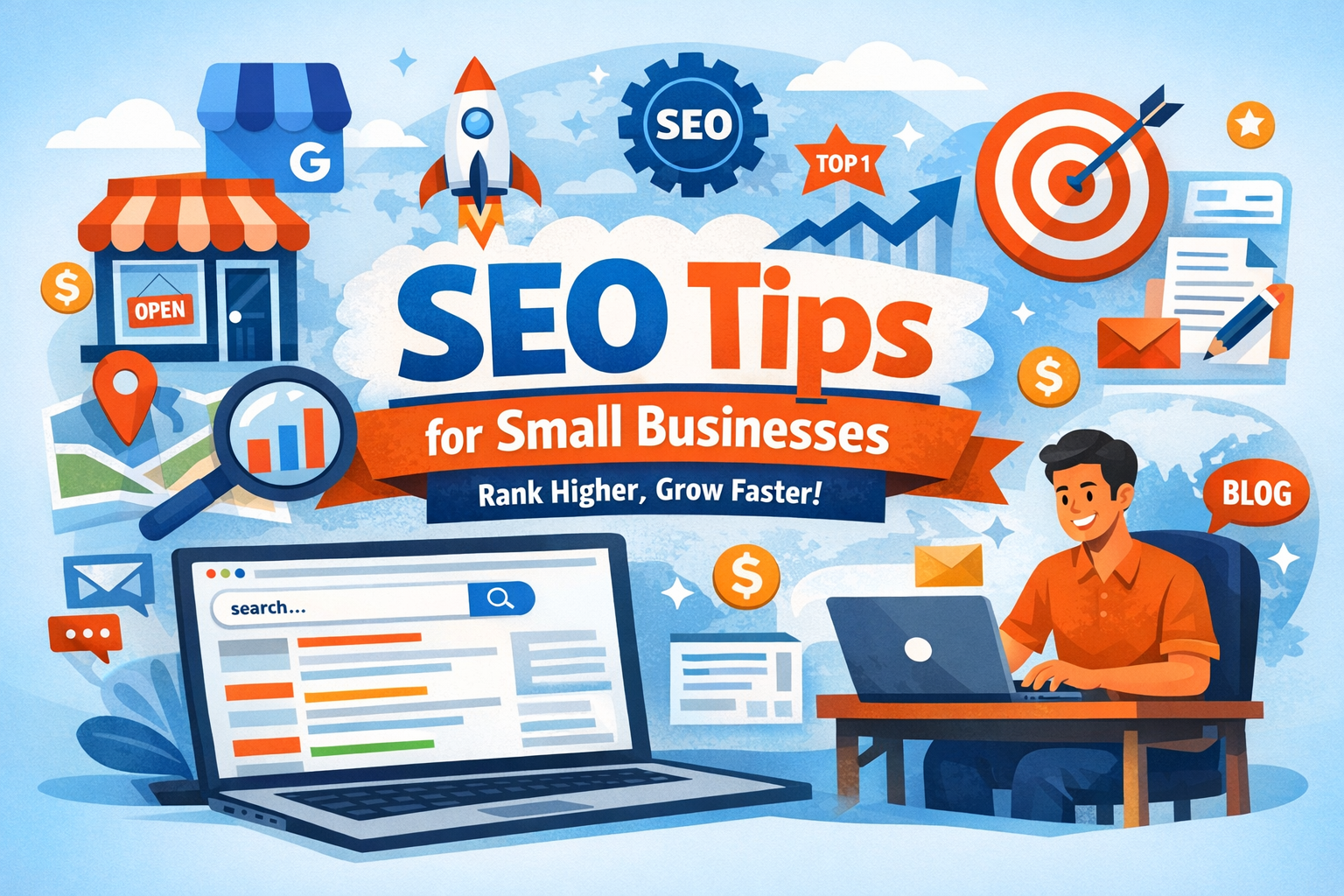

If you’re a small business owner, you’ve probably heard that “you need SEO.” But what does that really mean — and more importantly — how can you use it to grow your business without a massive marketing budget?
Search Engine Optimization (SEO) isn’t just for big corporations with full-time marketing teams. In fact, some of the most powerful SEO tips for small businesses are simple, practical, and affordable. When done right, SEO helps your business appear in front of customers exactly when they’re searching for your products or services.
Let’s break it down step by step.
Why SEO Matters for Small Businesses
Imagine someone in your area searches for “best bakery near me” or “affordable web designer in Chicago.” If your business doesn’t appear on the first page of search results, you’re practically invisible.
Studies consistently show that most users never go past the first page of search results. That’s why SEO isn’t optional anymore — it’s essential.
For small businesses, SEO offers:
- Increased online visibility
- More qualified traffic
- Higher credibility and trust
- Long-term, cost-effective marketing
- A competitive edge over local competitors
The good news? You don’t need to outspend big brands. You just need to be smarter and more strategic.
H2: Start With Keyword Research (The Foundation of SEO)
Every successful SEO strategy begins with understanding what your customers are searching for.
When we talk about SEO tips for small businesses, keyword research always comes first. Keywords are the phrases your potential customers type into search engines.
H3: How to Find the Right Keywords
You don’t need expensive tools to start. Free tools like Google Keyword Planner and Ubersuggest can help you identify relevant keywords with good search volume and low competition.
For example:
- A local gym might target “personal trainer in Austin”
- A florist might optimize for “wedding bouquets in Miami”
- A cleaning service could target “affordable house cleaning near me”
Focus on:
- Local keywords
- Long-tail keywords (longer, more specific phrases)
- Buyer-intent keywords
Long-tail keywords are especially powerful for small businesses because they’re less competitive and often convert better.
H2: Optimize Your Website for On-Page SEO
Once you’ve identified your keywords, the next step is optimizing your website.
On-page SEO refers to everything you can control directly on your website.
H3: Key On-Page SEO Elements
Here’s a practical checklist:
1. Title Tags
Your page title should include your main keyword naturally. For example:
“Affordable Web Design Services in Dallas | YourBrand”
2. Meta Descriptions
Write compelling meta descriptions that encourage users to click.
3. Headings (H1, H2, H3)
Structure your content clearly. Search engines love well-organized pages.
4. Internal Linking
Link to other relevant pages on your website to improve navigation and SEO.
5. Image Optimization
Use descriptive file names and alt text with keywords where relevant.
Small changes here can significantly improve your rankings over time.
H2: Focus on Local SEO (Your Secret Weapon)
One of the most powerful SEO tips for small businesses is leveraging local SEO.
If you serve a specific geographic area, local optimization can drive highly targeted traffic.
H3: Optimize Your Google Business Profile
Your Google Business Profile (formerly Google My Business) is critical.
Make sure:
- Your name, address, and phone number (NAP) are consistent
- You choose the correct business category
- You upload high-quality images
- You respond to customer reviews
- You post updates regularly
For example, a small café that consistently updates its profile with new menu items and responds to reviews is more likely to appear in the local map pack than a competitor with an inactive profile.
Local citations on directories like Yelp and industry-specific listings also strengthen your local presence.
H2: Create High-Quality Content That Solves Problems
Content marketing and SEO go hand in hand.
Search engines prioritize helpful, informative content. That’s why blogging is one of the most effective SEO strategies for small businesses.
H3: What Should You Write About?
Think about your customers’ questions.
If you’re a roofing contractor, write blog posts like:
- “How to Know When Your Roof Needs Repair”
- “Metal vs. Shingle Roof: Which Is Better?”
- “How Much Does Roof Replacement Cost?”
By answering real questions, you:
- Build authority
- Increase organic traffic
- Attract qualified leads
For example, a small accounting firm that regularly publishes tax-saving tips can rank for keywords like “small business tax deductions” and attract business owners searching for help.
Consistency matters more than volume. One high-quality article per month is better than four rushed posts.
H2: Improve Website Speed and Mobile Experience
User experience is a ranking factor.
If your website loads slowly or looks terrible on mobile devices, visitors will leave — and search engines notice.
H3: Quick Wins for Better Performance
- Compress images
- Use reliable hosting
- Enable caching
- Choose a mobile-friendly design
- Minimize unnecessary plugins
More than half of all web traffic comes from mobile devices. If your website isn’t optimized for smartphones, you’re losing customers daily.
H2: Build High-Quality Backlinks
Backlinks are links from other websites pointing to yours. They act like “votes of confidence” in the eyes of search engines.
For small businesses, backlinks don’t have to be complicated.
H3: Simple Ways to Get Backlinks
- Partner with local organizations
- Sponsor community events
- Write guest posts
- Get featured in local news
- Collaborate with bloggers
For instance, a local restaurant that gets featured in a regional food blog gains both visibility and SEO authority.
Focus on quality over quantity. A few relevant backlinks are more valuable than dozens of low-quality ones.
H2: Track Your Results and Adjust
SEO isn’t a one-time task. It’s an ongoing process.
Use tools like:
- Google Analytics
- Google Search Console
Track:
- Organic traffic
- Keyword rankings
- Click-through rates
- Conversion rates
If a page is ranking on page two, a small update (adding more content, optimizing headings, improving internal links) can push it to page one.
Successful SEO for small businesses is about testing, learning, and refining.
H2: Real-Life Example: Small Business SEO Success
Consider a small local landscaping company struggling to compete with larger competitors.
Instead of spending thousands on ads, they:
- Optimized their website for “landscaping services in [city]”
- Created blog posts answering seasonal lawn care questions
- Improved their Google Business Profile
- Collected customer reviews consistently
Within six months, they saw:
- A 60% increase in organic traffic
- More phone calls from local customers
- Higher-quality leads
This is the power of applying the right SEO tips for small businesses consistently.
H2: Common SEO Mistakes to Avoid
Even the best strategies can fail if you make these mistakes:
- Keyword stuffing
- Ignoring mobile optimization
- Publishing thin or duplicate content
- Not updating old content
- Expecting instant results
SEO takes time. Most businesses begin seeing measurable improvements within three to six months.
Patience and consistency win.
Conclusion: Small Steps Lead to Big Results
SEO might seem overwhelming at first, but it doesn’t have to be.
By applying these practical SEO tips for small businesses — focusing on keyword research, local optimization, content creation, website performance, and backlinks — you can steadily increase your online visibility and attract more customers.
You don’t need a massive budget. You need a clear strategy and consistent effort.
Start small. Optimize one page. Write one helpful blog post. Improve your Google Business Profile. Track your results.
Over time, those small steps compound into significant growth.
And in today’s digital world, that growth can be the difference between surviving — and thriving.